🔬Research
NewSkill Training Periodization in “Specialist” Sports Coaching — An Introduction of the “PoST” Framework for Skill Development
Flavius Andrisca
4 May 2026
57 views
enU12-U16U17+Skill AcquisitionApplication
Fabian W. Otte, Sarah-Kate Millar, Stefanie Klatt
German Sport University Cologne, Auckland University of Technology
Frontiers in Sports and Active Living·2019
10.3389/fspor.2019.00061Open Access — CC BY.
Description
A conceptual framework explaining how coaches can structure and periodize skill development through representative learning environments, constraints manipulation and progressive information complexity.
Applied Summary
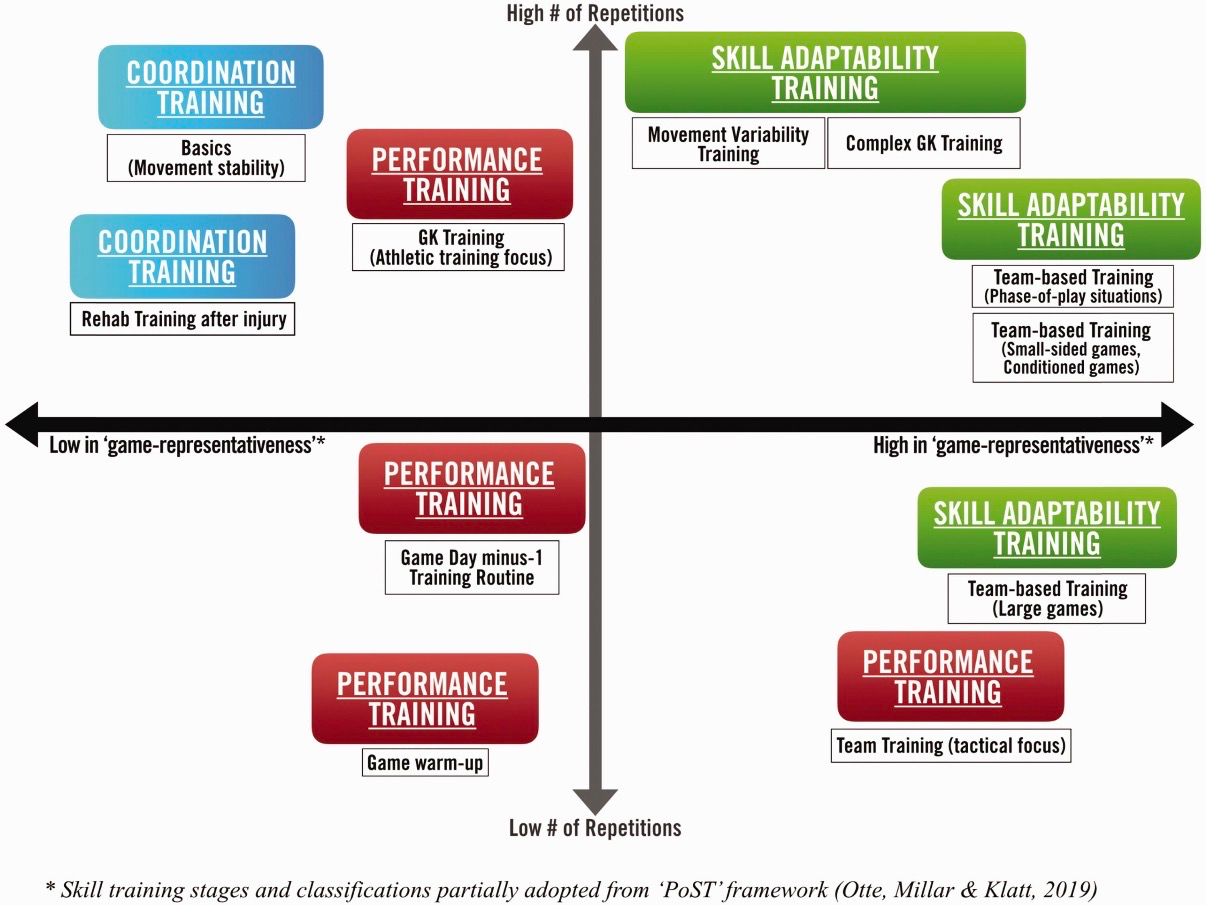
The article introduces the PoST Framework (Periodization of Skill Training), designed to help coaches structure skill acquisition over time. The framework is grounded in ecological dynamics and the constraints-led approach, emphasizing representative training, movement adaptability and perception-action coupling. Unlike physiological periodization, skill learning often lacks long-term organization. The authors propose a model that helps coaches manipulate information complexity, stability-instability balance and representative game demands across sessions and training cycles. The paper uses goalkeeper coaching as an applied example because specialist coaching environments frequently involve small groups and reduced game realism.
Relevance for Coaches
This paper helps coaches move away from isolated drills and toward structured skill environments that evolve progressively. It provides a logic for how to increase challenge without losing learning relevance.
Concrete Application
* Periodize perception-action demands across weeks. * Manipulate constraints intentionally. * Progress from lower to higher information complexity. * Maintain representative affordances even in small-group training. * Design sessions based on movement adaptability, not repetition.
Assumptions about the Child
Learning is nonlinear. Skill emerges through interaction between player, task and environment. Adaptation is more important than technical replication.
Limits and Risks
The framework is conceptual and requires interpretation. Coaches without understanding of ecological dynamics may apply the model superficially or reduce it to drill sequencing.
Pedagogical Intent
This resource targets the development of adaptable skill behaviour through structured manipulation of constraints and representative learning design. It supports autonomy by helping players attune to information, solve movement problems and regulate actions within changing environments. The framework encourages coaches to guide learning through task design rather than constant instruction. It activates relational dynamics between player, task, coach and performance environment across different timescales of development. It aims to improve long-term skill transfer by organizing learning progression around information complexity and perception–action coupling.
Working Hypothesis
If coaches progressively manipulate constraints and information complexity, then players may develop more adaptable and transferable skill behaviors, because movement solutions emerge through interaction with representative environments.
Failure Conditions
Unsuitable Context
rigid drill-based academiescoach-centered instructionlow adaptability environments
Probable Misreading
confusing variability with randomnessassuming complexity means chaos
Pedagogical Risk
adding difficulty without preserving representative information
A structured terrain report from anyone who has applied this resource in real practice.
Loading field notes...
Quick Info
Type
🔬Research
Status
NewVersion
v1.0
Language
en
Age Groups
U12-U16, U17+
Duration
60 min
Complexity
advanced
Secondary Themes
Constraints Led AproachPeriodisationRepresentative Learning DesignSpecialist Coaching